
Why Every German Learner Needs a Spickzettel 📝
Hey there, future German masters!
Let’s be honest for a moment. You’ve decided to learn German. You’re brave, you’re motivated, and then… you meet Der, Die, and Das. And just when you think you’ve got them memorised, they transform into Dem, Den, and Des like some kind of linguistic Transformers. But that’s not, where it stops – just think of the Adjektivdeklinationen and all the things a German Präposition wants 🤯…
If you feel like your head is spinning, don’t worry—you aren’t “bad at languages.” German grammar is a giant puzzle, and even the smartest students can’t hold all the pieces at once in the beginning (and not so beginning anymore). That’s why today, I’m giving you permission to do something your old school teachers might have hated: I want you to cheat.
Well, okay, not cheat in an exam, obviously. But I want you to use a Spickzettel (a cheat sheet).
Why Your Brain is Screaming for Help
When you are at the A1 or A2 level, your brain is doing a marathon. You are trying to:
- Remember the vocabulary.
- Pronounce the soft “ch” and “ü” correctly.
- Not forget the verb at the end of the sentence in a Nebensatz.
- And figure out if “Table” is masculine, feminine, or neuter.
That is a lot of cognitive load. If you spend 5 minutes trying to remember if mit takes the Dativ or Akkusativ, you lose the flow of the conversation. A Spickzettel acts like an external hard drive for your brain. It stays on your desk, pocket or phone, and when you get stuck, you just glance down. Boom. Knowledge unlocked.
The “Big Three” of Your Cheat Sheet
A good Spickzettel shouldn’t be a 500-page book. It needs to be one single page. Here is what I’ve included in the download for you:
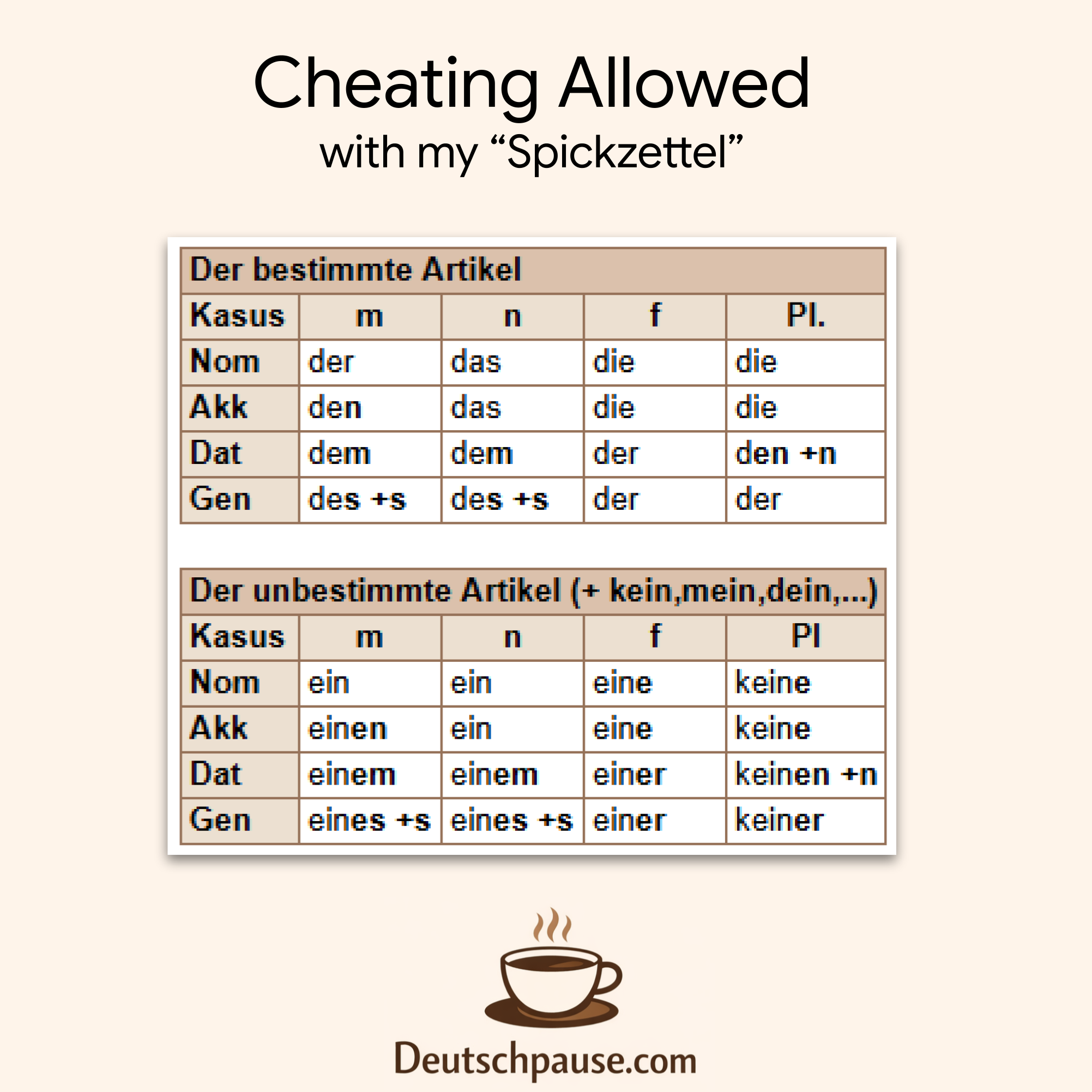
1. The Article Matrix
In German, the articles change based on the Case (Nominativ, Akkusativ, Dativ, Genitiv), and we have different articles: determined, undetermined, possessive… and some more.
2. Adjective Endings (The “Monster”)
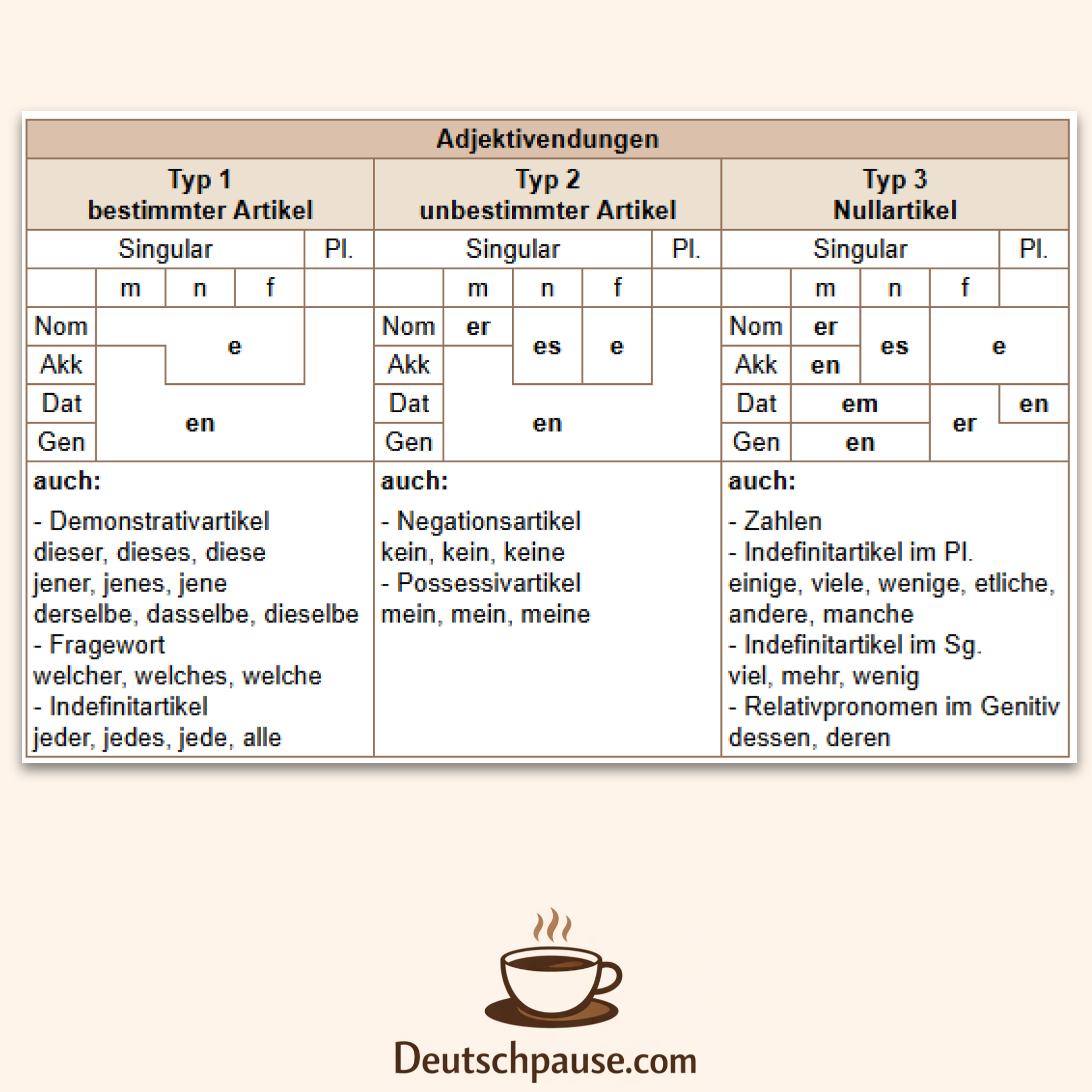
Adjective endings are the “Spielverderber” (party-pooper) of German grammar. Do you say “der gute Mann” or “ein guter Mann”? On your Spickzettel, we simplify this into a logical flow chart. In the beginning, it might seem overwhelming. But once you understood the system of the endings and how to look for them in this overview, it will become much easier, I promise. You will eventually dream of this chart 😴!
3. Prepositions: The Directional Guide
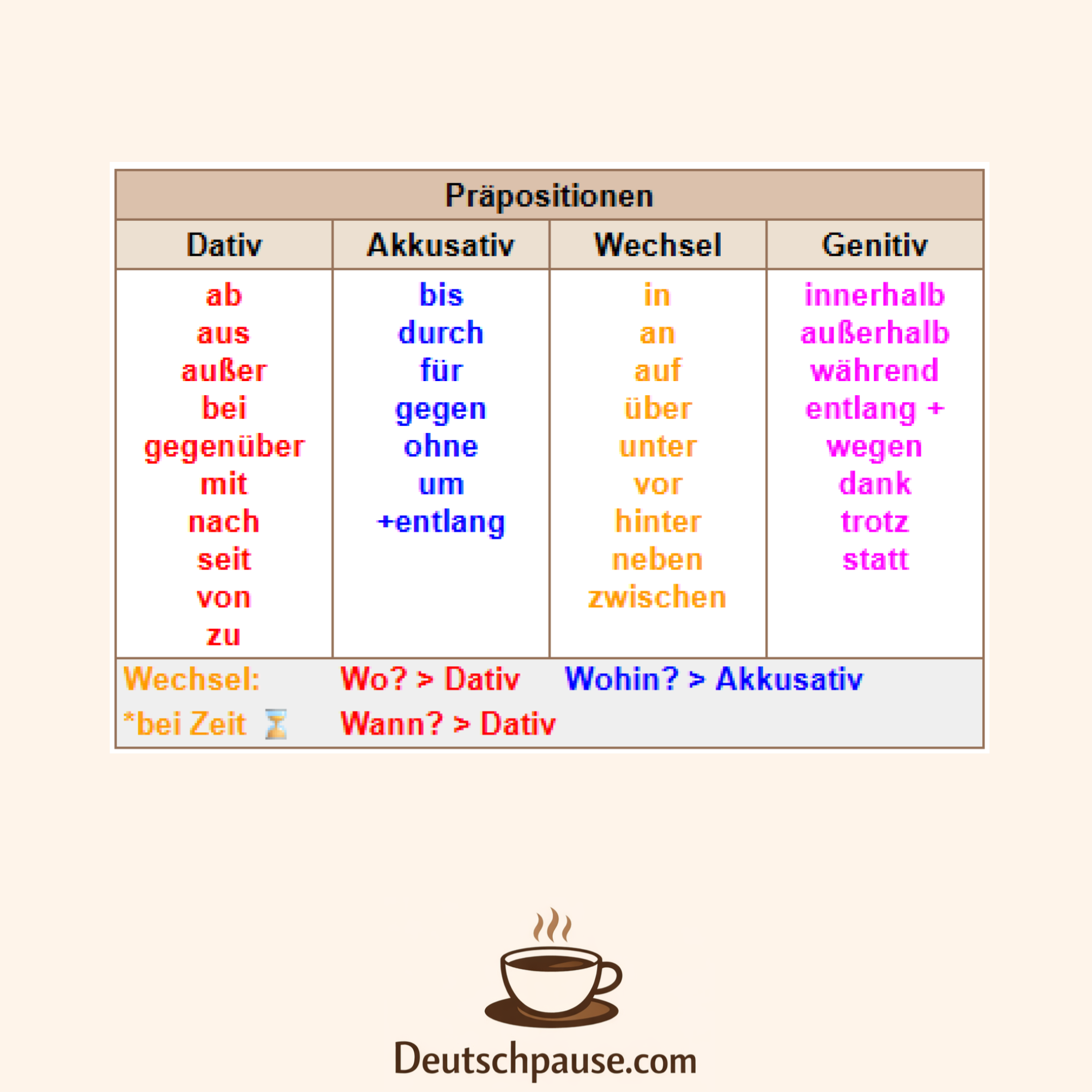
Prepositions tell you where things are or where they are going.
- The Dativ-only list: (aus, bei, mit, nach, seit, von, zu).
- The Akkusativ-only list: (durch, für, gegen, ohne, um).
- Two-Way Prepositions: The ones that change depending on movement!
How can we memorise them effectively? Some people use songs or mnemonics-techniques. Another simple idea is a table using a colour-code for visual learning. Red for dative, blue for accusative, orange for Wechselpräpositionen, and pink for genitive (you are allowed to ingnore thise for now). You will simply remember “mit” being red, which triggers the information: dative.
How to Use Your Spickzettel Effectively
Today, we will consolidate all this information is a handy one-page-sheet (check out the download below).
But don’t just hide it in a drawer! To really improve, you need to use it actively:
- Tape it to your laptop: Right next to the screen.
- Use it for homework: Every time you write a sentence, check your sheet. Eventually, you will stop looking because your eyes “know” where the information is.
- The “Glance” Rule: Try to guess the form first, then look at the sheet to confirm. This builds muscle memory.
The more you use the sheet, the more your brain gets used to the forms. Eventually, you will just “know” the correct form due to so many contious repetitions. That’s what we are aiming at!
Stop Being a Perfectionist!
Many students think, “I shouldn’t need a list; I should just know it.” Listen to your German teacher: No. Even professional translators have reference books on their desks. By using a Spickzettel, you are training your brain to see the patterns, to visualise contents. After a few months of “cheating,” you’ll realize you haven’t looked at the paper in days. That is the moment you’ve truly learned it.
Ready to make your life 100% easier?
CLICK HERE TO DOWNLOAD THE ULTIMATE GERMAN CHEAT SHEET (PDF)
⬇️
Want to use your Spickzettel? Check out the Artikel-Profi: